
Harford County Arrest Records and Charges
A Harford County arrest record is the law-enforcement side of an event. It may involve the arresting agency, booking, custody, incident report, crash report, warrant service, or agency records check. The court charge record is different. It begins when a charging document reaches the District Court or Circuit Court and becomes part of the criminal case summary or file. A person can be arrested before final charges are screened, and one arrest can lead to several charges, reduced charges, no charges, or a later indictment.
The Harford County Sheriff's Office is the local agency source for many sheriff records, while Maryland Judiciary Case Search is the main court route for filed charges. For custody status after booking, the detention center points users to VINE and other custody channels. For the full court case, including pleas, motions, disposition, and sentencing, the better match is Harford County criminal court records.
The official Harford County Sheriff's Office homepage is a starting point for agency context, wanted links, detention pages, and records-request routing.
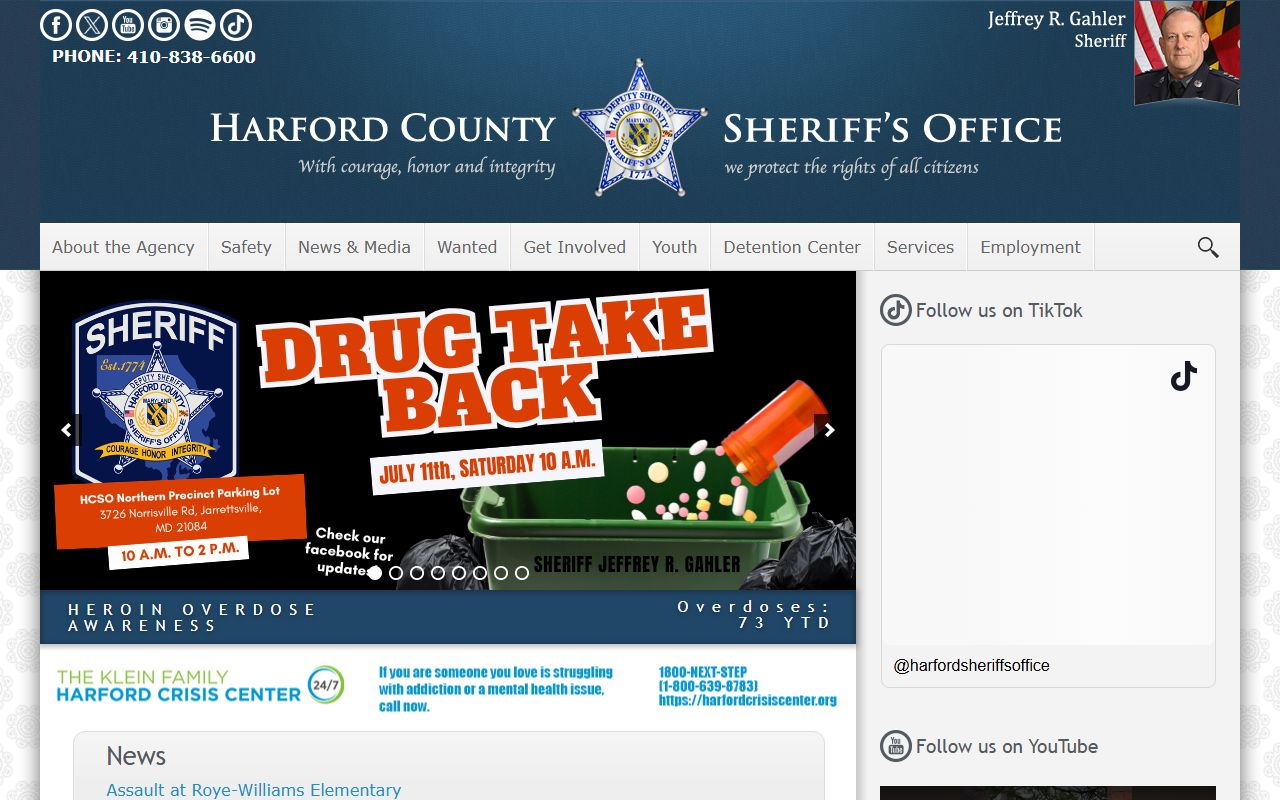
That sheriff source is useful for agency records, but it does not replace the court docket once charges have been filed.
| Record Type | Who Holds It | What It Can Show |
|---|---|---|
| Arrest or incident record | HCSO or another police agency | Agency event, report, crash record, records check, or investigatory material if releasable |
| Jail custody status | HCDC, VINE, DPSCS for state custody | Custody status, notification channel, and state-prison location when applicable |
| Court charge record | District Court or Circuit Court | Charge, case number, court date, disposition, and public docket entries |
| Complete criminal case file | Clerk for the court that heard the case | Pleadings, motions, orders, plea, trial, sentence, and certified copies if public |
Find Harford Arrest Records and Charges
Start with the track that matches the record. If the question is whether a charge was filed in court, use Maryland Judiciary Case Search and search by name or case number. Case Search can show public charge and disposition information, but it is a public summary. Complete files and certified copies are handled by the Harford Clerk of the Circuit Court for Circuit Court matters or the District Court clerk for District Court matters.
If the question is a sheriff incident report, crash report, or agency records check, use the HCSO public-records route. The HCSO GovQuest portal provides New Request, Find a Request, and Search Self-Service Records options. Crash reports are routed separately to CrashDocs, and the research notes that HCSO says to allow up to 10 business days for upload.
- Search Case Search for filed court charges by name or case number.
- Check whether the case is in District Court or Circuit Court before calling a clerk.
- Use GovQuest for HCSO agency records, reports, or records-check requests.
- Use HCDC, VINE, or DPSCS for custody status rather than treating Case Search as a jail roster.
- Confirm sealed, expunged, juvenile, or investigatory limits with the proper custodian.
Harford Court Charges After Arrest
Maryland charging can appear through several document types. Traffic and some criminal matters may begin with a citation. Other criminal matters may begin with a statement of charges, criminal information, or indictment. The State's Attorney is the local prosecution office for many criminal filings and charging decisions. Law enforcement may start the process, but the prosecutor and court filings control what becomes the court charge record.
The Harford County State's Attorney website provides local prosecution context and public updates on criminal cases.

State's Attorney material can help explain prosecution posture, but the court file remains the source for filed charges, docket entries, and dispositions.
| Charging Document | How It Works | Where It Appears |
|---|---|---|
| Citation | A charge issued by an authorized officer or person, common in traffic and some criminal matters | Often searched in District Court through Case Search |
| Statement of charges | A criminal charging document that starts or supports prosecution in court | District Court or Circuit Court depending on case posture |
| Information | A prosecutor-filed charging document | Criminal case file and docket |
| Indictment | A formal criminal charge returned by a grand jury | Usually associated with serious Circuit Court criminal matters |
Process: arrest or citation > charge screening > charging document > arraignment or first appearance > pretrial hearings > plea, trial, dismissal, nolle prosequi, or sentencing.
Harford Charge Status Terms
Charge status matters because an arrest or filed charge is not the same thing as a conviction. A public summary can show an original charge, an amended charge, a dismissal, a nolle prosequi, probation before judgment, conviction, or other disposition. Maryland terminology can be confusing, so the disposition field should be read with the case events and not as a single-word background check.
| Status | Plain Meaning | Why It Matters |
|---|---|---|
| Pending | The charge has not reached final court outcome | Future hearings, plea, trial, dismissal, or amendment may follow |
| Amended or reduced | The filed charge changed from the original form | Read the current charge and final disposition, not just the first entry |
| Dismissed | The charge ended without a conviction on that charge | Expungement eligibility may depend on the full case and timing |
| Nolle prosequi | The prosecutor chose not to proceed on the charge | This is not the same as a guilty finding |
| Probation before judgment | Maryland disposition where judgment is stayed under conditions | It can carry court conditions and has its own record consequences |
Charge vs. conviction: A charge states an accusation filed in court. A conviction is a court outcome finding guilt.
Harford County charge records can also move between practical stages. A person may be booked at HCDC while charges are pending in District Court. A misdemeanor or certain felony may start in District Court, while a serious felony, indictment, jury-trial matter, or appeal may move through Circuit Court. A charge may also be connected to a warrant, bond condition, probation issue, or later sentencing entry. Read the charge list with the court name, event dates, and final disposition before drawing a conclusion.
Harford Agency Records Requests
For sheriff reports, agency records checks, and some arrest-side materials, HCSO records are handled through agency channels. GovQuest is the official public-records portal identified in the research. HCSO also routes crash reports to CrashDocs. Records checks for law enforcement, government agencies, and military uses may require a signed authorization release sent by fax or email to the records unit.
The official HCSO GovQuest public portal is the records-request channel documented for Harford County Sheriff's Office requests.
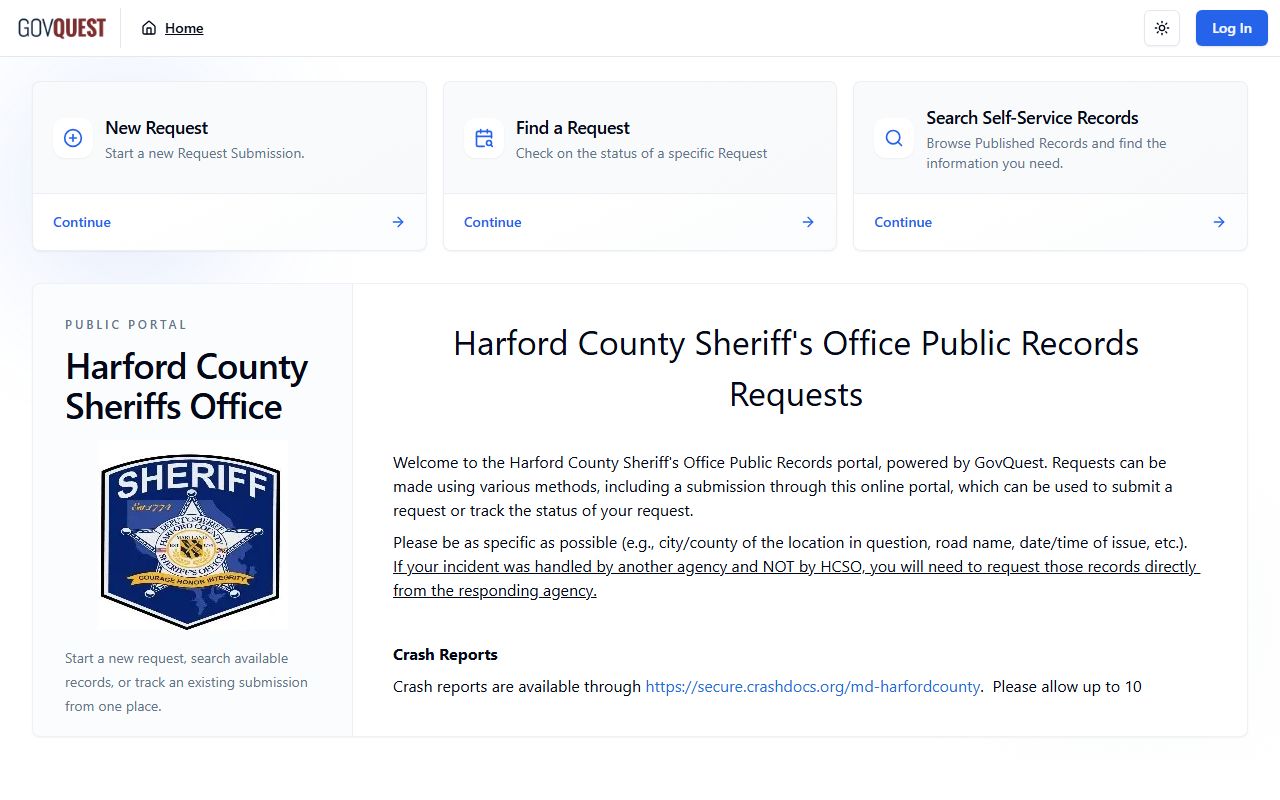
GovQuest is separate from Case Search, so a requester may need both an agency request and a court search to understand an arrest-to-charge sequence.
Maryland General Provisions §4-351 allows denial or limitation of law-enforcement and prosecution investigatory records in specified circumstances. That is why an open criminal investigation, sealed warrant material, victim information, juvenile information, medical data, or evidence details may not be released through an ordinary public request.
Defense and Prosecution Records
The Maryland Office of the Public Defender is the statewide public-defense agency, and Harford County is in OPD District III. Public Defender files are not public court-record repositories. They are defense files and may include confidential attorney-client material. For the public case record, use Case Search and the proper court clerk. For appointed counsel status, check the court docket or contact OPD through official eligibility channels.
The Maryland Office of the Public Defender is the statewide public-defense source, not a public criminal-history database.

Defense records, prosecution records, agency reports, and court files each have different access rules, so the office named in a docket entry is not always the office that can release a record.
Restricted Harford Charge Records
Some Harford County arrest records and court charge records are not public. Juvenile police and court records are confidential under Courts and Judicial Proceedings §3-8A-27. Sealed and expunged records are removed from ordinary public access. Adoption, some mental health matters, protected addresses, minor identifying information, financial account data, and active investigatory material may also be withheld or redacted.
Maryland expungement rules in Criminal Procedure §§10-105 and 10-110 provide paths for some non-convictions, specified dispositions, and eligible convictions. A person usually needs the exact case number and disposition, then files the proper petition in the court that handled the case. The District Court cost schedule lists a $30 petition fee for expungement of guilty dispositions only, so current forms and fee instructions should be checked before filing.
| Restricted Record | Likely Reason | Next Step |
|---|---|---|
| Juvenile charge | Juvenile confidentiality | Do not search public adult tools for juvenile case details |
| Expunged charge | Court order removed eligible record from public view | Use the issuing court if authorized to ask about the order |
| Active investigation | Investigatory-record limits | Expect denial, redaction, or delay from the agency custodian |
| Sealed court file | Court rule, statute, or order restricts access | Party, attorney, agency, or court order may be required |
Note: Confirm a charge outcome with the court that handled the case before relying on a public summary for legal or personal decisions.
Harford Booking to Court Case
The arrest-to-charges path can cross several Harford County offices in a short time. HCDC handles local custody and detention rules. The Sheriff's Office or another police agency keeps the incident, arrest, crash, or investigative record. The State's Attorney screens and prosecutes many criminal cases. District Court and Circuit Court keep the public docket and official case file once the charging document is filed.
That split explains why one search rarely answers every question. VINE may tell a family member that custody status changed. Case Search may show a court date or disposition. GovQuest may be needed for a releasable sheriff report. The clerk may be needed for certified copies or complete-file inspection. Each step should use the record number, case number, or identifying details from the prior source to avoid a broad and error-prone search.